
Window Fall Prevention
Secure the Window. Stop the Fall.
Falls are the most common unintentional injuries that send children to the hospital. Young children are naturally curious and top-heavy, which increases their risk of falling through a window opened more than 4 inches. Across the United States, thousands of children are injured or killed each year due to window falls. MultiCare Mary Bridge Children’s Hospital treats about 33 pediatric window falls each year, with more than 25% coming from just five Pierce County zip codes. Three of those hotspot zip codes fall within the Central Pierce Fire & Rescue service area: 98387 (Spanaway/Frederickson); 98374 (Puyallup/South Hill); and 98444 (Parkland/Spanaway/East Tacoma).
The good news is that window falls are preventable.
Central Pierce Fire & Rescue is committed to empowering families with window stop devices, practical safety tips, and the knowledge needed to help keep children and our entire community safe at home. We recommend the use of removable or releasable window stop devices that limit window openings to four inches during normal use, while still allowing adults to quickly and fully open the window in an emergency.
Madden's Story
On Memorial Day weekend in 2023, the Thompson family was spending time together at home, hosting a cookout with neighbors while their children played upstairs.
Madden was in her bedroom, where her lofted bed sat near an open window. Wanting to ask her parents a question, she climbed onto the bed and leaned against the window screen. In an instant, the screen gave way.
Madden fell from the window while the adults were just outside.
Her father, Ben, ran to her side and immediately knew what had happened when he saw the missing screen. Madden was awake and talking, but in severe pain. First responders quickly arrived and transported her to Mary Bridge Children’s.
Doctors determined she had a serious fracture in her femur near her hip. That night, Madden underwent surgery that required a plate and eight screws. Her recovery took months. She spent three months unable to put weight on her leg, relying on a walker or being carried, and gradually worked her way back to walking, running, and returning to the activities she loves.
Today, Madden has recovered. However, her family’s perspective on home safety has changed.
“We had talked to our kids about window safety,” said her father, Ben Thompson, a firefighter with Central Pierce Fire & Rescue. “What we didn’t realize was how easily a screen can pop out. The day after her injury, we installed window stops throughout our home. Looking back, I wish we had done it the day we moved in.”
Madden’s story is a reminder that window falls can happen quickly, even when caregivers are nearby and safety has been discussed.
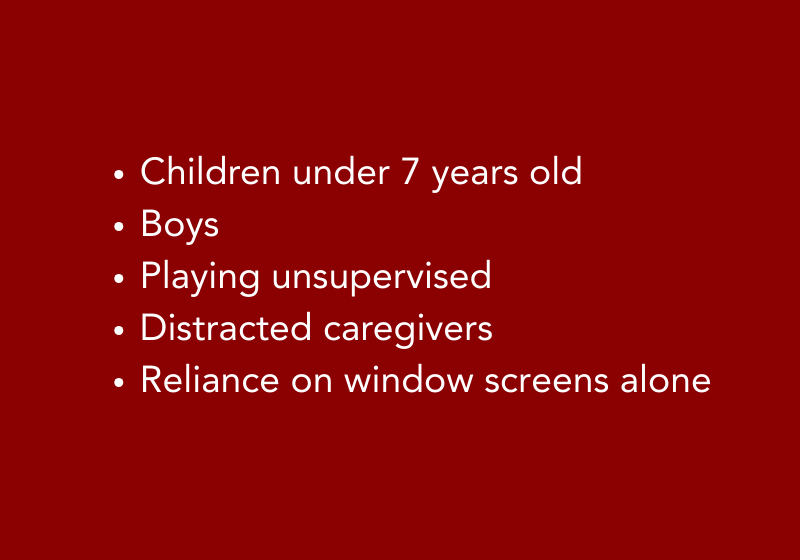
Risk Factors
Prevention Tips
- Warmer weather often means open windows, which increases the risk of falls for young children.
- Prioritize installing window stops in children’s bedrooms, play areas, and any window more than six feet above the ground outside.
- Install window stops to prevent windows from opening more than four inches.
- Choose window stops that an adult can quickly remove or collapse in an emergency.
- Keep windows closed and locked when not in use.
- Always supervise children, especially near open windows.
- Remember that window screens keep bugs out, not children in.
- Move furniture away from windows to discourage climbing.
- Teach children not to play near windows, but do not rely on them to remember this rule.
- If your windows open from the top, use that option whenever possible.
- Avoid letting children watch you operate window safety devices.
- When visiting places that are not child-proofed, close and lock windows and supervise your child closely.
Emergency Planning & Window Stops
 After installing window stops in your home, it is important to consider them when planning for an emergency escape. You may need to discuss what it means to shelter-in-place with your children. Additionally, you may deem them responsible enough to know how to disable the window stop in the case of an emergency. As a reminder, it is also important that your smoke alarms are working properly for early detection of a fire. Every home and family is unique, and your emergency escape plan should meet your specific needs.
Frequently Asked Questions (FAQs)
-
How common are window falls?
-
- Falls are the #1 cause of injury hospitalization for children in the US.
- Each year, 3,500 to 5,000 children in the U.S. are hospitalized after falling from windows.
- On average, 12 children die each year.
- 70% of falls are from second or third-story windows.
- Pierce County has the highest number of window falls in Washington State
-
Who is most at risk?
-
Young children, especially those under age 7, are at the highest risk for window falls. Curiosity, climbing, and limited awareness of danger increase the likelihood of children falling from an open window.
Older adults and individuals with disabilities may also face increased risk due to balance difficulties, mobility limitations, or health conditions that affect stability.
Simple prevention measures, including supervision and properly installed window stop devices, can significantly reduce risk for all vulnerable members of the household.
-
How do children fall out of windows?
-
Common causes include: pushing against a window screen, sitting or leaning on a window ledge or climbing on furniture situated near a window.
-
Do window screens help prevent falls?
-
No. Window screens are not designed as safety tools. They are meant to keep bugs out and cannot prevent a child from falling. Even young children can easily push through a standard window screen.
-
Are window falls a concern in single-story homes?
-
Yes. Falls from first-floor windows can still cause serious injuries, especially to young children. Any open window within reach poses a potential risk.
-
What is the difference between a window stop and window lock?
-
A window stop limits how far a window can open to help prevent window falls (usually 4 inches or less, to allow some airflow).
A window lock secures a window in the closed position for security but does not prevent a fall once the window is unlocked.
-
Are there any types of windows that have stops built in?
-

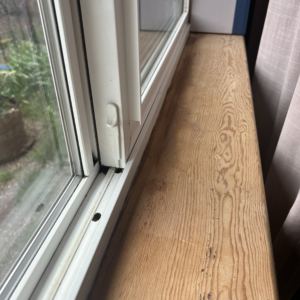 Yes. Some window manufacturers offer windows with built-in safety features called Window Opening Control Devices (WOCDs). These devices limit how far a window can open, typically to less than 4 inches, to help reduce the risk of falls.
Manufacturers that offer these options include (but are not limited to):
The pictures to the right show what built-in window stops may look like.
*Not all windows made by these manufacturers have built-in window stops. Visit the manufacturer’s website for more information.
-
What do I do in case of an emergency evacuation if my window has a stop on it?
-
Window stops should be removable or easily releasable from the inside. In an emergency, an adult should quickly disengage the device so that the window can be fully opened for escape. Make sure that all adults in your household know how the window stop operates and can release it without tools. Adults in the family may decide that children of a certain age or ability can also learn to disengage the window stop in case of an emergency; however, there is no set age or guideline for this determination. Families will need to evaluate individual needs and circumstances.
*While the provided information focuses on pediatric window falls, these same prevention strategies may also benefit older adults, individuals with disabilities, and others at increased risk of falls.
Thank You to Our Community Partners!
Thank you to Mary Bridge Children’s Hospital for partnering with us on this important injury prevention initiative.
We also extend our appreciation to Arrow Lumber and Lowe’s for their generous donation of materials supporting our window fall prevention display.
